Experience since 1999
Years of experience and technical expertise ensure the highest quality.

Select your language


Experience since 1999
Years of experience and technical expertise ensure the highest quality.
Quality You Can Trust
Every engine is thoroughly inspected and professionally rebuilt to the highest standards.
Comprehensive Service
Personal advice and comprehensive service tailored to your needs.
Fast & Reliable
Short delivery times and dependable service you can rely on.
Have you noticed increased 1.8 or 2.0 TFSI oil consumption in your Audi, VW, Škoda or Seat? Then you are one of almost 800,000 owners affected. Between early 2008 and mid-2011, over 800,000 vehicles were fitted with these engines.
To reduce friction and improve emissions, these engines were fitted with oil scraper rings (piston rings) that are too thin. They wear prematurely and become clogged. As a result oil consumption rises steadily – ultimately leading to catastrophic engine damage.
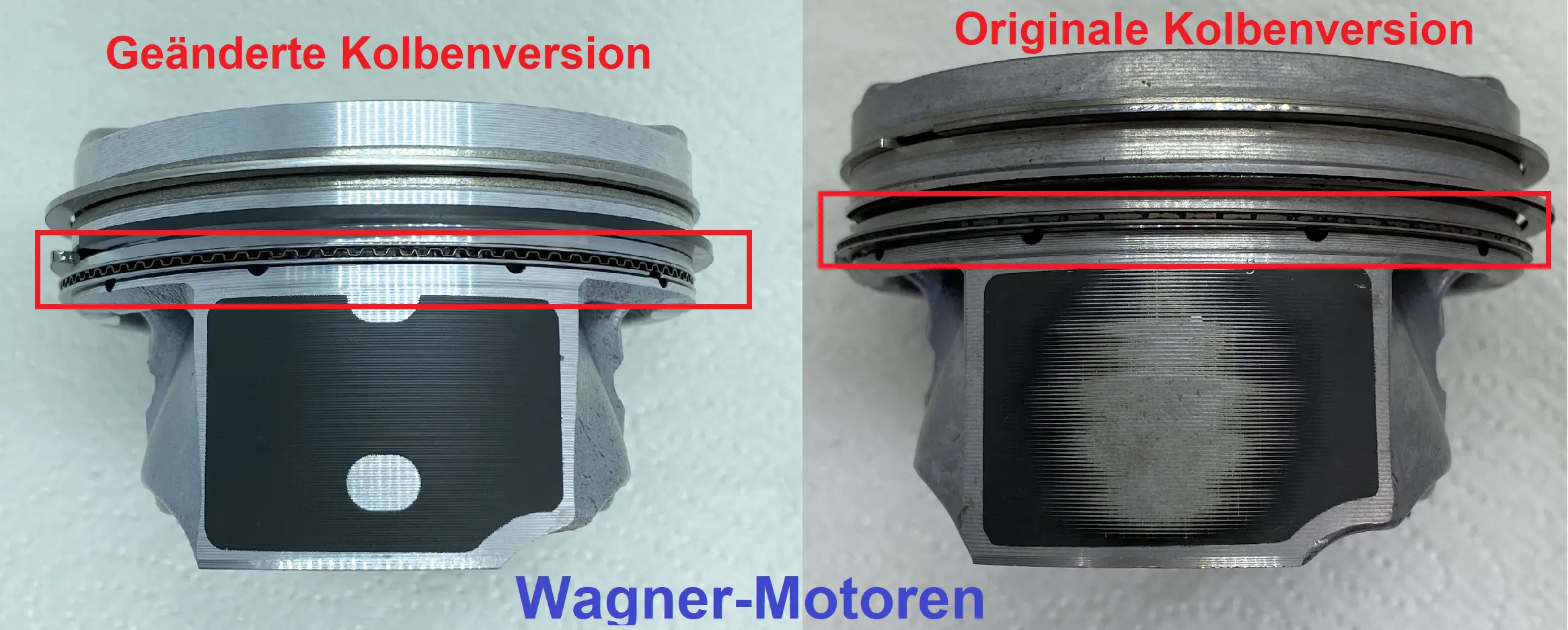
The oil scraper ring surrounds each piston and ensures that the piston skirt is lubricated and that oil does not travel upwards into the combustion chamber.
Because the oil scraper ring is too shallow and its drainage holes too small, those holes become blocked with carbon deposits. Once that happens, more and more engine oil is carried past the scraper ring into the combustion chamber and burnt there. That in turn creates yet more carbon residue – which you notice as ever-increasing oil consumption.
Because oil is constantly being burnt, the temperature in the combustion chamber rises. The consequences:
In our replacement engines we fit modified pistons with wider three-piece steel-laminated oil rings. The wider laminations of the oil scraper rings ensure optimum oil flow.
Our replacement engines also receive a new reinforced timing chain with a modified tensioner, since the timing chain is likewise known to cause problems on this engine. The matching engines (CDA, CDN, CDH, CAE, CAW, CCZ, CEA, CES) are listed under 1.8 or 2.0 TFSI.
The widespread claim that an engine uses no oil at all is fundamentally wrong. But which level of consumption is normal and which is excessive?
Every manufacturer specifies guide or limit values for its engines. If you suspect excessive oil consumption, ask your engine manufacturer – information can also be found in workshop manuals and handbooks.
If you have no precise figures, you can use the normally defined consumption of 0.1 % to 0.5 % of fuel consumption as a basis. A worked example:
Note that diesel engines use more oil than gasoline engines, and engines with a turbocharger use somewhat more, since the oil also lubricates the turbocharger. Oil consumption increases over an engine's life, so a slightly higher figure is normal in older engines.
On these engines it is common for only the piston rings to be replaced. We have since been contacted by many customers who subsequently suffered engine damage due to a jumped timing chain. As the timing chain problem is well known, all our replacement engines receive a new, modified chain.
There is also the economic argument: to change the piston rings, the engine has to be removed anyway. The labour, and therefore the cost, of replacing the piston rings and timing chain is barely different from a complete overhaul. During an overhaul all wearing parts are inspected and replaced as necessary – leaving you with an as-new engine.
Is your TFSI using too much oil? Send us the VIN or engine code – we will prepare a quotation for a replacement engine with modified pistons.
Our team is here to support you with expertise and experience – quickly, professionally and personally.

You can also explore our selection on:
